Since modern shampoo as we know it today didn’t come into existence until the 20th century, what did people do to wash their hair before then? What did they use back in the 19th century? Or even earlier than that?
Some people might answer that question by saying that people who lived back in “the olden days” had really bad hygiene and hardly ever even washed their hair.
This was probably true for some people back in the 19th century. I doubt, for example, that washing hair would have been very high on the priority list for miners during the Gold Rush era or for cowboys riding for weeks on the dusty plains.
The majority of people living during the Victorian era, though, made an effort to keep their bodies, including their heads, clean and fresh. Judging by the amount of hair care tips mentioned in various 19th century lady’s magazines and books about etiquette and health, the average Victorian woman cared very much about having healthy, beautiful hair.
Cleanliness is a Matter of Perception
By modern standards, our ancestors living during the 19th century and earlier might seem to have had poor standards of cleanliness because they didn’t take a shower and wash their hair every single day the way that most people do now.
There were a couple of different reasons for this. One reason was that washing their hair every day would have been very inconvenient and impractical, especially for women with waist-length hair. The process of heating up water, washing the hair, and then letting it dry without the aid of any modern blow-dryers would have been too time-consuming for the majority of the working- class and middle-class women, not to mention the fact that it probably would have been highly unpleasant in the cold of winter.
Even the wealthiest of women didn’t wash their hair every day, though. And one of the main reasons is that they simply didn’t need to. Without the harsh detergents in modern shampoos that strip the natural oils from the scalp, the hair of women in the Victorian era could go much longer between washings without getting too oily.
How frequently a woman washed her hair would have depended on social status – a socialite attending galas and fancy dinners would have put more of a priority on washing her hair than a homesteader struggling to survive on the prairie – and on the type of her hair, whether it was thick or thin, oily or dry, etc.
One book of the period, Hints on Health published in 1852, says that washing “once a week could scarcely be deemed too troublesome” (pg. 121).
Once a week might seem disgusting to modern shampooers who are used to lathering up their hair on a daily basis, but going a week or more between washings was perfectly acceptable back in the time before the creation of modern shampoo.
Victorian Shampoo Alternatives
I’ve listed several of the different natural hair-washing methods that I’ve come across while reading through my collection of 19th century books and magazines.
While some of these methods might work fine by themselves, most of them work best when combined with one another, or at least that’s what my experience has been.
The effectiveness of any of the methods also depends a lot on hair type and on water quality. Unlike modern shampoos which are formulated to work for specific hair types and for both hard and soft water, natural hair washes can take some tinkering to get just right for your own particular hair type and water quality.
Soap
~ “Many heads of hair require nothing more in the way of wash than soap and water” – pg. 317, Decorum (published 1879).
~ “To cleanse the hair, there is nothing better than soap and water . . . the soap, of course, should be mild, and well and plentifully rubbed in, and afterwards thoroughly removed with an abundance of water” – pg. 121, Hints on Health (published 1852).
From what I’ve read, soap seems to have been one of the most common old-fashioned hair washes. The soap would have been a castile soap or “toilet soap” as it was often called because it was milder than the soap that would have been used for washing laundry.
Soap can be a simple, natural way to wash your hair without stripping it of its natural oils. The only trouble is that, depending on the type of water you have, you might have to try a couple different soaps to find one that will lather well and wash out completely with the water that you have.
If you have very hard water, some soaps can leave a “sticky” feeling in your hair. The water in my shower is pretty hard, so I’ve experienced this stickiness before. Not very pleasant at all. After a bit of experimenting, though, I’ve found a soap that lathers well, rinses out completely, and leaves my hair feeling clean.
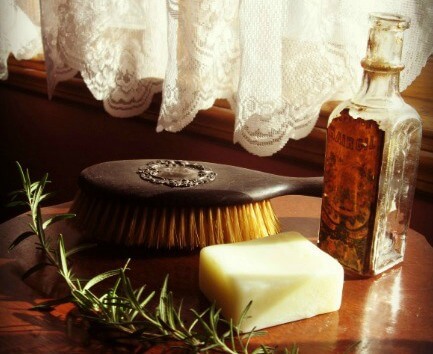
This is the soap
Update: 2/27/21 While I had good success using this soap previously, more recently I have experienced a bit of stickiness in my hair and some residue. This could be because something with the soap itself changed, or it could be because my water changed. Either way, I can attest to the fact that trying to use soap to wash your hair can be tricky.
I’ve actually seen some Victorian books recommending soft water or collecting rain water, so that might be one way that they avoided the issue of residue left from soap. I suppose that using distilled water to wash your hair might help with the issue, but it would also be less convenient than being able to just rinse your hair in the shower.
Vinegar
~ “Vinegar and water form a good wash for the roots of the hair” – pg. 316, Decorum (published 1879).
Vinegar is something that most people in the “real food” world are familiar with, especially those who have ever tried the “no poo” method. I gave “no poo” a try for a little while, but it just wasn’t working for me.
With the hard water in my shower, “no poo” was too finicky to try to get just the right amounts of baking soda and apple cider vinegar, and the results weren’t consistent for me. I love using apple cider vinegar as a rinse after washing my hair with castile soap, though.
The vinegar nicely balances out the ph of my hair and leaves it feeling soft and shiny afterwards. I use about a teaspoon diluted in a cup of water, but the best ratio of vinegar to water can vary depending on the type of hair you have, so don’t be afraid to experiment with different ratios of vinegar to water.
Black Tea
~ “If you want to have a good head of hair, never apply to cosmetics; use nothing else to clean it but strong, cold black tea. Rub it into the roots every evening before going to bed, with a little sponge, and every morning do the same. I generally use it, and recommend it to all ladies desirous of having a full head of hair” – pg. 261, Godey’s Lady’s Book (September 1867).
Using black tea is something that would be best for those with medium to dark hair. I’ve used it on my light brown hair with no problems, but it’s possible that it might temporarily darken very light blonde hair.
For my hair, using the tea by itself wasn’t enough to fully wash my hair and make it look clean, but I will occasionally use it as a rinse or rub it into the roots of my hair like the magazine suggests if I happen to have some handy.
The tea might work better as a cleanser for some people, depending on hair type and water type. I find it really interesting, though, that books and magazines of the 19th century were recommending such simple ways to care for the hair like using just black tea. Compare that one ingredient to the huge list of unpronounceable ingredients in modern shampoos and conditioners!
Rosemary
~ “Any preparation of rosemary forms an agreeable and highly cleansing wash” – pg. 317, Decorum (1879).
Rosemary is a natural way to add shine to your hair without having to use silicone-based conditioners and styling products.
My favorite way to use rosemary is to make a strong cup of rosemary tea, let it steep and cool down until it’s a comfortable temperature, and then use it as a rinse for my hair after I wash it.
If I’m using apple cider vinegar to rinse my hair, and I also want to use the rosemary, I use the rosemary tea to dilute the vinegar rather than just water. As another bonus, the rosemary smells really nice and helps to balance out the acidic scent of the vinegar.
Egg Yolks
~ “The yolk of an egg beaten up in warm water is an excellent application to the scalp” – pg. 317, Decorum (1879).
~ “To cleanse long hair – beat up the yelk of an egg with a pint of soft water. Apply it warm, and afterwards wash it out with warm water” – pg.458, Godey’s Lady’s Book (printed 1869).
Egg yolks are great to use as a mask to nourish and moisturize the hair. What I usually do, when I have the time, is to mix an egg yolk with some water (or a cup of rosemary tea for an extra shine boost) and coat my hair with the mixture. Then I wrap my hair up with a towel or shower cap and let the egg yolk mask sit in my hair for 10-15 minutes, or longer if I’m not in a hurry. Then I wash my hair as usual with the hair soap. It takes a little bit longer to do, but my hair always looks and feels so much nicer afterwards that it’s worth it!
Rum
“New England rum, constantly used to wash the hair, keeps it very clean, and free from disease, and promotes its growth a great deal more than Macassar oil. Brandy is very strengthening to the roots of the hair; but it has a hot, drying tendency, which N.E. rum has not” – pg. 12 The American Frugal Housewife (published 1833).
This method is one I haven’t tried, but I’d be curious to see how it works. Again, this seems like the type of method that might work better for some hair types than others.
For someone with really dry hair, the alcohol content might be too strong and harsh of a wash. For someone whose hair tends to be on the oily side, though, this might work just fine. This method would also only have been used once a week or possibly even more infrequently since daily hair washing wasn’t done back in the 19th century like it is today, so it would probably be best suited for an occasional clarifying wash.
(Brushing)
Even though it doesn’t really fall under the same category as a shampoo, brushing was very important back in the 19th century as a means to clean the hair and to keep it healthy.
Brushing with a natural bristle brush also helps to make the hair shiner by distributing the scalp’s natural oils down the entire length of the hair strand. To our ancestors, brushing the hair daily was considered even more important than other methods of washing and caring for the hair.
The Results Are Worth the Extra Effort
Using natural, traditional methods of caring for your hair can require a bit of tweaking to get a routine that fits right for your individual hair and water type. It also might take your hair a little while to adjust to the transition from chemical-based products to natural ones.
Once you find a method that works for your hair, though, it’s so much nicer to be able to use such simple household ingredients to care for your hair and not to worry about all of the harmful ingredients that most shampoos contain.
And, as an added bonus, it’s much cheaper too since most of the things you can use for washing your hair can already be found in your own kitchen!
Recommended Book:
If you like using natural hair care methods, you might enjoy reading The No Poo Method: Your Guide to Natural Hair Care by Ashlee Mayer. Ashlee’s book is a guide to all-natural, shampoo-free hair care with tips and recipes to help you have beautiful hair naturally.
Special discount! Readers of Our Heritage of Health can save 30% by using the coupon code “nopoo30” at checkout.

[socialpug_share]

Further reading about natural hair care:
All Natural Hair Care by Reformation Acres
Natural Homemade Products for Curly Hair by The Sweet Plantain
DIY Shampoo Recipe Roundup by Life Sanity
10 Tips for Going No-Poo by It’s A Love/Love Thing
This post is linked to: Sunday School at Butter Believer, Natural Living Monday at Natural Living Mamma, Clever Chicks Blog Hop at The Chicken Chick, Party Wave Wednesday at Holistic Squid, Natural Living Link-Up at Jill’s Home Remedies, Small Footprint Friday at Small Footprint Family.
Hi there, I have fine, straight hair, so finding a good alternative to shampoo that leaves my hair soft and not greasy- or stringy-looking is a struggle. I was just wondering what type of hair you have, and if you might have any specific recommendations for fine, straight hair that tends towards oily. Thank you!
Hi Emily, my hair actually sounds very similar to yours. Mine is mostly straight with a slight bit of a wave, it’s pretty fine, and it tends to get oily pretty quickly too. I’ve found that the J.R. Ligget’s soap I mentioned above works really well for my hair. So far, that’s the best non-shampoo method I’ve tried that actually works for me.
Awesome, I’ll have to try that out then! Thank you, Lori! 🙂
I just discovered another one this week – I have used it only once so far, but WOW! I will definitely keep using BEER on my hair! I added about a tbs of apple cider vinegar to a bottle/can of beer – I started with dry hair, saturated it with the beer, and let is soak for about 20-30 mins, then just water-rinsed it in the shower. Afterward, there was a slight beer smell in my hair, but only until it dried – like the vinegar, I found the odor dissapated completely once dried.
Interesting! I bet people probably used beer a lot for their hair too back in earlier centuries just like with the rum. Thanks for sharing with us!
I used to wash my hair every day–when I got older (and perhaps lazier–lol), I washed it less and my hair actually got thicker, healthier. I can go four or five days without washing it. When I do, I use J.R. Ligget’s bar shampoo and some commercial macadamia oil conditioner (I NEED conditioner). I will try the vinegar rinse! Thank you for your wonderful blog … it is so fascinating and I’m grateful for folks like you who do a lot of research and share the information with others!
That’s awesome that your hair got thicker and healthier, Melissa! And thank you – I’m so glad it was helpful! 🙂
I use Dr. Bronner’s – either the regular castille or the Shikakai – both work great for me. The trick is to get it rinsed out thoroughly before applying an acidic rinse (absolutely necessary, in my experience). My hair is really thick and goes more than halfway down my back – I wash it 1-2 times per MONTH – and really, that’s not even necessary, I just enjoy it. I use an acidic rinse of lemon juice or apple cider vinegar every time I shower, whether I use soap or not – this keeps my hair and scalp happy. My hair has never looked or felt better in my life (I’ve been “no-poo” for over two-and-a-half years). I’ve also stopped losing my hair at a really fast rate. Just try different formulas and give your hair and scalp plenty of time to adjust!
Hey lady! I keep forgetting to tell you, I’ve been using the J. R. Liggitt’s based on your recommendation, and I’m loving it.
I water-washed for about 5 years, but pregnancy often changes hair–mine got more oily, so I’ve needed a little something more than water once in a while… the Liggitt’s is perfect!
– -vanessa
Hey! 🙂 That’s awesome that it’s working so well for you! I really like it, and I love the fact that it’s a local New England product too.
I just wanted to say thank you forth this article and whole website! I just found it and can’t wait to try everything 🙂
My most favorite method is to wash with baking soda either sprinkled on to my scalp or diluted in one to two cups of water then poured on and followed with a apple cider vinager rinse. Once i was working again and could treat myself i tried to use modern day hair washing methods again and my hair got mad at me and felt super gross; so to this day, if i do use shampoo, I have to baking soda rinse first and i buy nice shampoo because it takes me a year to go through a whole bottle because i use i twice a month. Now i can enjoy the best of both hair washing worlds and save a bundle.
I am enjoy finding more and more people who use alternative washing methods. I stopped using traditional shampoo on a regular basis a few years ago, not because I was trying to go natural or green but because I was out of work and needed to save money.
I am new to this blogging community, but so far I’m really loving the things I’m reading about!
Anyway, my mom, sister and I all tried J.R. Ligget’s bar shampoo and got different results. My mom recieved great results right away, and my sister and I weren’t so sure at first. The bar shampoo left my hair feeling oily and tangly the first couple days. For my sister, the results just kept getting worse. Her hair was so oily, she stopped using the shampoo. I’ve stuck with it and am seeing better results. I am going to start using an apple cider vinegar rinse, which is what my mother does. Let’s see how it works out for me!
I hope it ends up working for you! A lot of people have a transition period when they switch to using more natural hair washes. I didn’t really have one because I went from using a regular shampoo to a slightly more natural organic shampoo, to an even more natural organic shampoo, and then finally to the J.R. Ligget’s bar shampoo. So I think my hair had enough time to gradually get used to being washed with less chemicals and more natural ingredients.
This is something I have wondered about. Thanks
for sharing….
Laura of Harvest Lane Cottage
Thank you for sharing with the Clever Chicks Blog Hop this week; I hope you’ll join us again!
Cheers,
Kathy Shea Mormino
The Chicken Chick
http://www.The-Chicken-Chick.com
I love this, all the research and great quotes are so fun! History teaches us so much. I had never heard of using black tea and will give that a try.
Thanks for sharing on Natural Living Monday!
This comment has been removed by the author.
Hello, how often do you have to wash your hair with soap and do a vinegar rinse? Does it allow you to go more days between washes then shampoo?
I usually wash my hair about three times a week. That seems to be what works best for my hair and for my schedule. With shampoo, I used to wash every day, so it’s really nice to be able to do just three times a week rather than seven! I’m hoping that as my hair and scalp continue to adjust I might be able to go even longer eventually 🙂